The Classical World: The Foundations of the West and the Enduring Legacy of Antiquity by Nigel Spivey
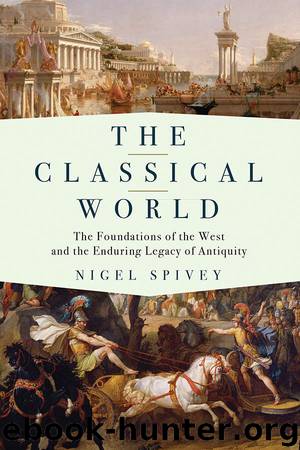
Author:Nigel Spivey [Spivey, Nigel]
Language: eng
Format: epub, mobi
Publisher: Pegasus Books
Published: 2016-07-05T07:00:00+00:00
They brought me bitter news to hear, and bitter tears to shed.
I wept, as I remembered how often you and I
Had tired the sun with talking, and sent him down the sky.
And now that thou art lying, my dear old Carian guest
A handful of grey ashes, long, long ago at rest
Still are thy pleasant voices, thy nightingales, awake;
For Death, he taketh all away, but them he cannot take.
The bibliographer’s disposition is nicely reflected in the eventual formation of poetic ‘garlands’ – the gathering of ‘literary flowers’ implied by the Greek term anthologia, and represented by the Greek Anthology, a collection that has charmed readers down the centuries. Yet a roll-call of poets at the Ptolemaic court contains enough by way of distinguished names to prove that veneration of ‘classic’ forebears did not deter fresh creative effort. Theocritus, a migrant to Alexandria from Syracuse, contrived the genre of pastoral: lyrical ‘little visions’ (‘idylls’) of an idealized countryside where shepherds while away time by singing of love, transience and death. Posidippus, who came from Pella, pioneered the word-picture known as ekphrasis (‘speaking out’): he may be regarded as the prototype, poetically, of the informative head-set that many viewers of paintings and sculptures in modern museums like to use. And Herodas, perhaps from Kos, amused the court with ‘mimes’ that parodied the low life on the streets outside.There was a price to pay, in terms of flattery: Ptolemy I styled himself as Soter, ‘saviour’, and the poets did not balk at hailing him as omnipotent Zeus. A particularly unctuous poem by Callimachus told how a curl of hair from the head of Berenike (III) became a constellation. But such is patronage. The poets could dutifully trill a monarch’s praise; it cost an astronomer nothing to name a new star after the queen; and mathematicians of genius, such as Eratosthenes, who calculated the earth’s circumference to an unprecedented degree of accuracy, could simply dedicate their equations to Ptolemy.
• • •
While the Ptolemies were diligent custodians of high culture, they also exploited the potency of ‘pomp and circumstance’ – what is sometimes called the ‘theatre state’, a monarchical style built upon lavish shows and spectacles. Processions featuring giant automata of deities, along with liberal rations of wine distributed to every household, ensured Alexandria’s fame for its carnivals and religious parades. Ptolemy I shrewdly assessed that his kingdom, founded in a spirit of inter-ethnic unity or ‘single-mindedness’ (homonoia) perhaps taken from Alexander, needed a cult figure (apart from himself) without sectarian associations. So he introduced the god Sarapis. The origins of this deity remain obscure, and possibly they always were. Functionally Sarapis was versatile, connecting with fertility, universal order and the Underworld; for a consort he took Isis, long revered by the Egyptians as ‘Lady of All’. How priests of the new cult squared Sarapis with the old tales of Isis searching for the dismembered Osiris, her brother and husband, is a theological topic beyond the scope of this book. Suffice it to say that Sarapis flourished throughout the classical world for half a millennium.
Download
The Classical World: The Foundations of the West and the Enduring Legacy of Antiquity by Nigel Spivey.mobi
This site does not store any files on its server. We only index and link to content provided by other sites. Please contact the content providers to delete copyright contents if any and email us, we'll remove relevant links or contents immediately.
| Africa | Americas |
| Arctic & Antarctica | Asia |
| Australia & Oceania | Europe |
| Middle East | Russia |
| United States | World |
| Ancient Civilizations | Military |
| Historical Study & Educational Resources |
Cecilia; Or, Memoirs of an Heiress — Volume 1 by Fanny Burney(32558)
Cecilia; Or, Memoirs of an Heiress — Volume 2 by Fanny Burney(31956)
Cecilia; Or, Memoirs of an Heiress — Volume 3 by Fanny Burney(31940)
The Secret History by Donna Tartt(19083)
Sapiens: A Brief History of Humankind by Yuval Noah Harari(14389)
Leonardo da Vinci by Walter Isaacson(13336)
The Radium Girls by Kate Moore(12026)
Sapiens by Yuval Noah Harari(5369)
How Democracies Die by Steven Levitsky & Daniel Ziblatt(5218)
The Wind in My Hair by Masih Alinejad(5095)
Homo Deus: A Brief History of Tomorrow by Yuval Noah Harari(4918)
Endurance: Shackleton's Incredible Voyage by Alfred Lansing(4780)
Man's Search for Meaning by Viktor Frankl(4604)
The Silk Roads by Peter Frankopan(4532)
Millionaire: The Philanderer, Gambler, and Duelist Who Invented Modern Finance by Janet Gleeson(4478)
The Rape of Nanking by Iris Chang(4211)
Joan of Arc by Mary Gordon(4109)
The Motorcycle Diaries by Ernesto Che Guevara(4098)
Stalin by Stephen Kotkin(3965)
